Genetic Inheritance
Sickle cell Anaemia is an autosomal recessive (SS) disease. In order to inherit a recessive disorder two copies of a mutated gene must be passed on. people who get the recessive disease normally have parents who carry one copy of the mutated gene and are therefore carriers.
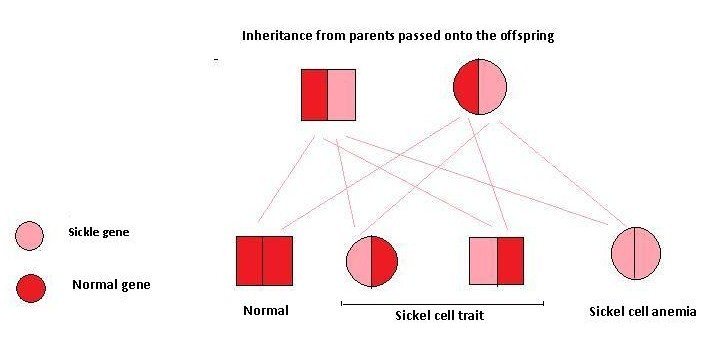
If each parent carries two healthy haemoglobin genes (HH) then the child will develop as normal. However if each parent carries one sickle haemoglobin and one normal haemoglobin gene (HS) then this will result in the child having:
- 25% chance of inheriting two sickle genes in which they would have sickle cell Anaemia.
- 25% chance of inheriting two normal haemoglobin genes which means they don’t have sickle cell Anaemia.
-
50% chance of being a sickle cell carrier whose unaffected. This condition is called the "sickle cell trait" where the child has inherited one normal copy of haemoglobin gene from one parent and a sickle haemoglobin gene from the other parent.
Diagram to illustrate the chances of Inheriting Sickel cell Anaemia